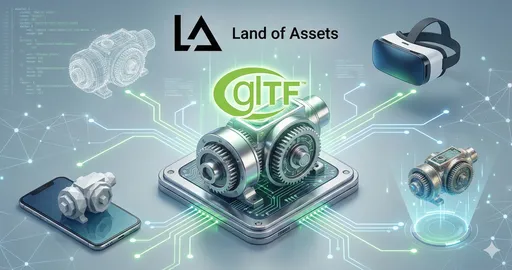
Why Land of Assets Standardizes on glTF
Why "Land of Assets" Standardizes on glTF for the Master Asset
A deep dive into why Land of Assets chose glTF as the interchange standard for Master Assets — and why we also natively support Blender and FreeCAD as source formats, two open platforms that represent where the industry is going.
Ben Houston • 7 min read • February 19, 2026
Over the course of my career — from contributing to Three.js and the glTF standardization committee, to building 3D tools at companies like Exocortex, ThreeKit, and Frantic Films — I've spent a lot of time thinking about how 3D data moves. Whether in VFX pipelines or web-based product visualizers, the core challenge is almost always the same: interchangeability.
Today, at my new endeavor, "Land of Assets," we tackle the massive investment that goes into creating core visualization assets. Whether these 3D models are handcrafted by expert artists, generated by AI, or captured via scanning and photogrammetry, they represent a significant outlay of time and capital. To protect that investment, assets need to be future-proof. They must look consistently excellent today, tomorrow, and a decade from now, across any platform.
That is exactly why "Land of Assets" has standardized on glTF as the backbone of our Master Asset approach.
The Master Asset Concept
Before diving into the "why" of glTF, it's crucial to understand our philosophy of the "Master Asset." A Master Asset is your single source of truth. It's a relatively high-resolution asset featuring detailed meshes and beautiful, high-res textures — something you can zoom in on and admire the craftsmanship.
You only want to pay to create this master asset once. But to guarantee it looks exactly as intended forever, it must be stored in a universally understood format. That format must prioritize broad compatibility over proprietary bells and whistles.
glTF: The Distillation of Standards
This brings us to glTF's superpower: it is the distillation of standards.
glTF does not try to push the boundaries of 3D technology in any one specific dimension. Instead, it represents the common denominator. It is what the industry collectively agrees is the standard for shared 3D data.
Consider procedural geometry in Blender. Their node graphs are amazing pieces of technology, allowing for incredibly complex, non-destructive workflows. But that proceduralism is not natively interchangeable with Unreal Engine, Maya, or a WebGL viewer. Therefore, you won't find it in glTF. glTF prioritizes what can be universally read, ensuring that what you see in one tool is exactly what you get in another.
Here's an example of a glTF Master Asset from Land of Assets — you can orbit and zoom to see the result of that interchangeability:
The USD Contrast: The "Everything Tool" vs. The "Everywhere Standard"
At this point, you might be asking: "What about USD?"
Universal Scene Description (USD) is a fantastic format. In fact, at "Land of Assets," we do support exporting to USD for pipelines that explicitly require it. But we do not use it as our foundational Master Asset format.
Why? Because USD has effectively become the "everything tool." Most Digital Content Creation (DCC) applications — Maya, 3ds Max, Katana, Modo — have written custom extensions to USD to save out their highly specific features. You can write out a USD from Maya, load it back into Maya, and retain all of Maya's proprietary data.
However, if you take that Maya-flavored USD and drop it into Katana or Modo, those extensions either won't work, will barely work, or will result in an asset that looks completely different. USD is incredibly effective when you want to push the state of the art within a specific, closed pipeline where everyone is using the exact same toolset. But its fragmented nature makes it a poor standard for genuine, cross-platform interchangeability. You should not standardize your universal asset library on USD. You should standardize on glTF.
Source Formats: Where Content Is Created vs. Where It Lives
Standardizing on glTF as the interchange format doesn't mean every asset starts life as a glTF file. Most 3D content is created in dedicated authoring tools — and those tools have their own native formats that are richer, more flexible, and more appropriate for the creation workflow than a delivery-optimized interchange format.
At Land of Assets, we natively accept two source formats alongside glTF: Blender (.blend) and FreeCAD (.FCStd), as well as the standard CAD interchange formats STEP and IGES. When you upload any of these, the platform automatically converts them to an optimized glTF Master Asset for delivery — while preserving the original source file for future parametric configuration and re-export.
The reason we've prioritized Blender and FreeCAD specifically is not just technical. It's a deliberate alignment with where the industry is going.
Blender: The Open Standard for 3D Creation
Blender has undergone a remarkable transformation over the past decade. It has moved from a niche open-source tool to the dominant 3D creation platform for product visualization, VFX, and interactive content. The Blender Foundation's commitment to open development, the quality of the modern rendering and compositing pipeline, and its adoption across the community have made it genuinely competitive with — and in many workflows, preferred over — expensive commercial tools like Maya and 3ds Max.
For product visualization specifically, Blender is increasingly where the assets are created. Supporting native .blend uploads means your team works in the tool they know, without a manual export step and without the versioning friction that comes from maintaining both a Blender source file and a separately-exported glTF.
We believe Blender's trajectory is clear. Open, community-driven, and improving rapidly — it is the future of accessible, high-quality 3D content creation. Land of Assets is built to be aligned with that future.
FreeCAD: The Open Standard for Parametric CAD
FreeCAD occupies a similar position in the CAD world that Blender holds in 3D creation: a serious, open-source parametric CAD tool that is closing the gap with commercial alternatives like SolidWorks and CATIA.
For manufacturers and product teams, the significance of FreeCAD support goes beyond just accepting another file format. Parametric CAD files are not static models — they encode the engineering logic of a product. Dimensions, constraints, and assembly relationships can all be reconfigured. When Land of Assets ingests a FreeCAD source file, it preserves that parametric structure, enabling configuration directly from engineering source data rather than from a pre-baked library of 3D variants.
A door that is parametrically defined in FreeCAD — with configurable width, height, glass options, and hardware — can drive a product configurator that enforces real manufacturing constraints, generates accurate geometry for every valid configuration, and produces a bill of materials and engineering drawings as first-class outputs. That is a qualitatively different capability from a configurator built on manually exported, fixed 3D variants.
Like Blender, FreeCAD's direction is clear. As open-source tooling matures and as more engineering teams adopt it, the ability to ingest native FreeCAD files directly — without a conversion pipeline your team has to maintain — becomes increasingly valuable. We're building for that future too.
The Evolution of Standards
Standards evolve as new technologies mature and achieve true interoperability across the ecosystem. Take MaterialX, for example — a node-based material interchange format that looks poised to become the new benchmark. It currently has support in several renderers and in Maya, but it's still missing in 3ds Max, and has only partial implementation in Blender and other tools. Because it is not yet fully interchangeable everywhere, it isn't the universal standard yet. But as that ecosystem matures, formats like glTF will adapt to integrate these proven, stabilized technologies.
Until then, we rely on the proven stability of the current glTF specification. Standardizing on glTF ensures your Master Asset remains the definitive, uncorrupted version of your product, ready to be deployed anywhere — while native support for Blender and FreeCAD ensures that the creation and engineering workflows your team already uses feed naturally into that standard.
The Broader Point
There is a theme running through these choices: we are deliberately building Land of Assets to align with open platforms rather than proprietary ones, and with the future of the industry rather than its past.
glTF is an open standard. Blender is open source. FreeCAD is open source. The interoperability we're building toward is not dependent on any vendor's roadmap or pricing decision. That matters for the longevity of your asset investment, and it matters for ours.
Having a perfect, high-resolution Master Asset is only half the battle, of course. If you're dropping a massive file into an e-commerce viewer, it's going to cost you. That's where the second half of the Land of Assets equation comes in: our automated optimization pipeline, which I'll cover in my next post.
This post is also available on Ben Houston's blog.
